BETAWOOLeD City is still being tested. Features may change, and sets or scores may be reset before launch.

WOOLeD City

O-Level revision where every subject is a kampung and every student is a sheep. Gather your flock, sit the same timed paper together, and learn the traps before the exam springs them.

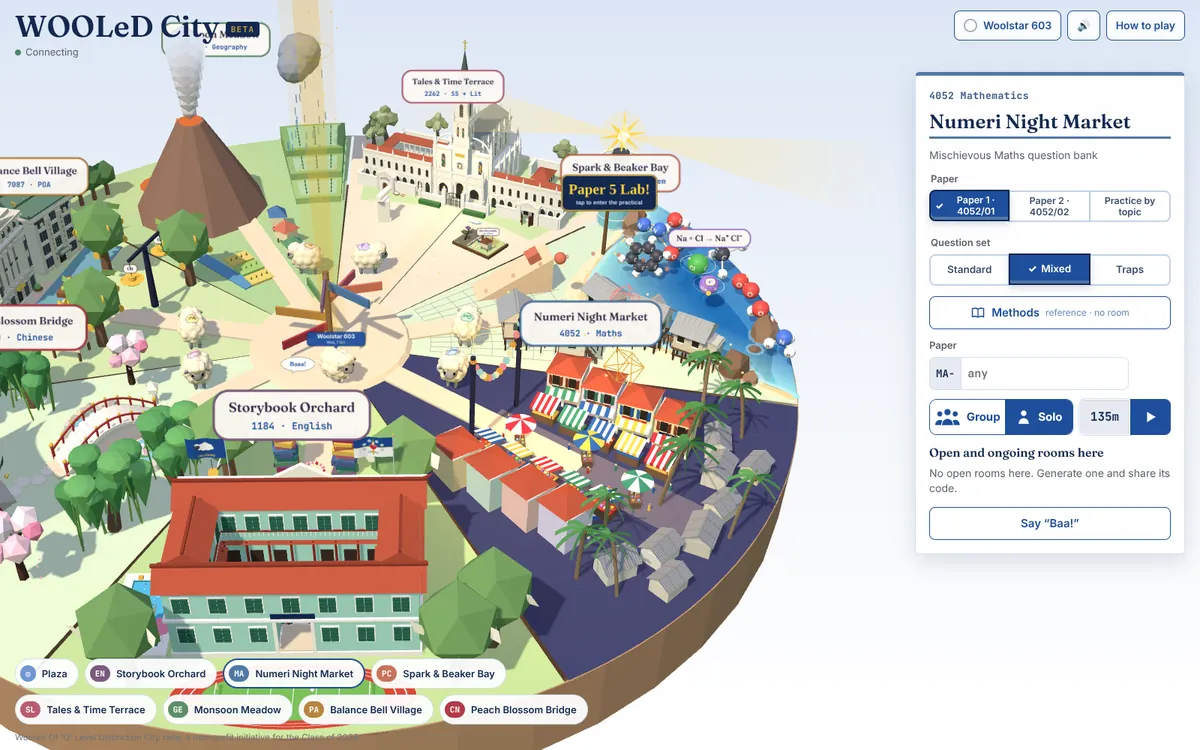
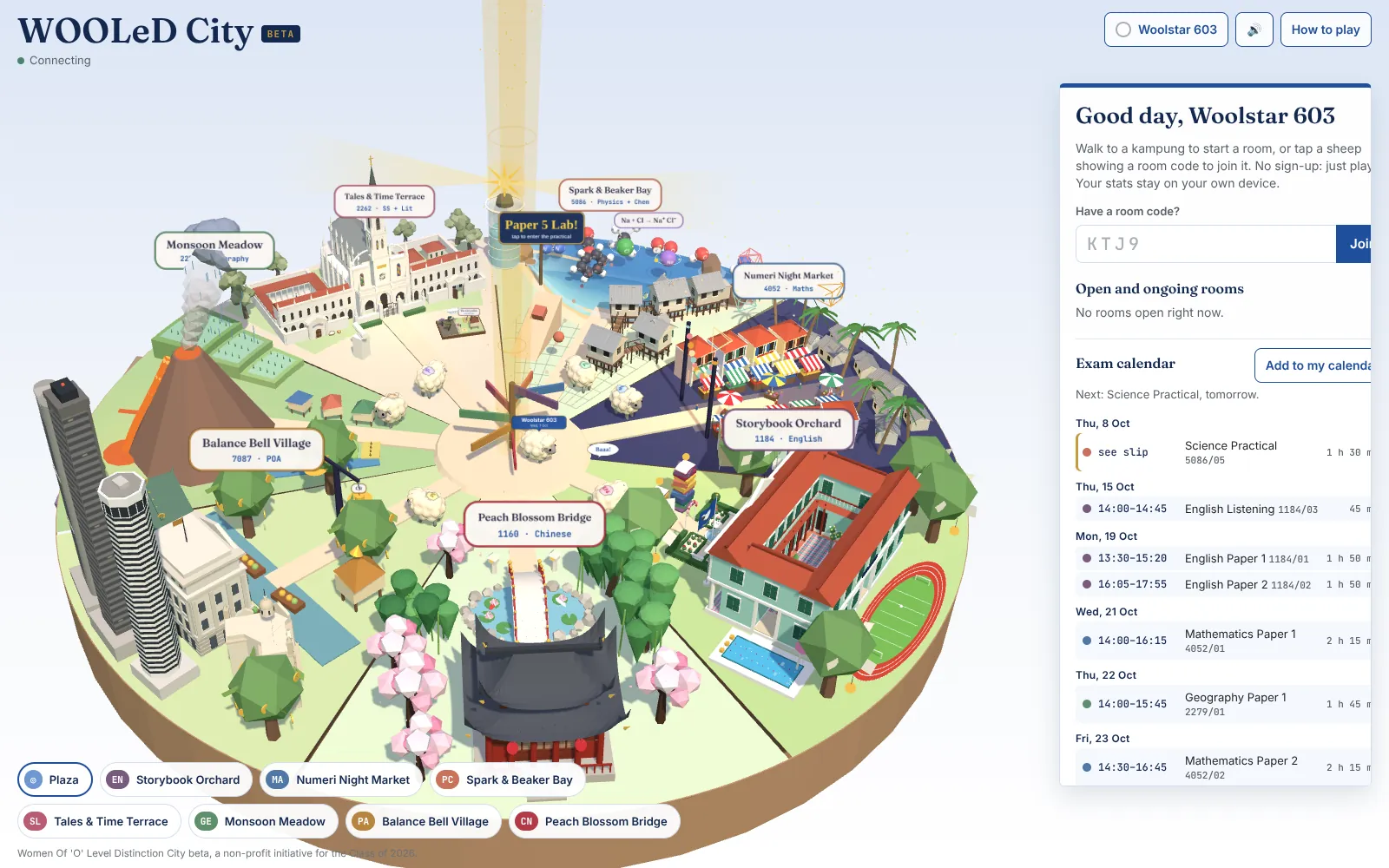
WOOLeD City: seven kampungs around the Plaza, each with its name board, sheep grazing, and the Spark & Beaker lighthouse in the bay

How it works

Free and open to everyone, no sign-up. Your own stats stay in your browser, on your device.

  1. Be a sheep

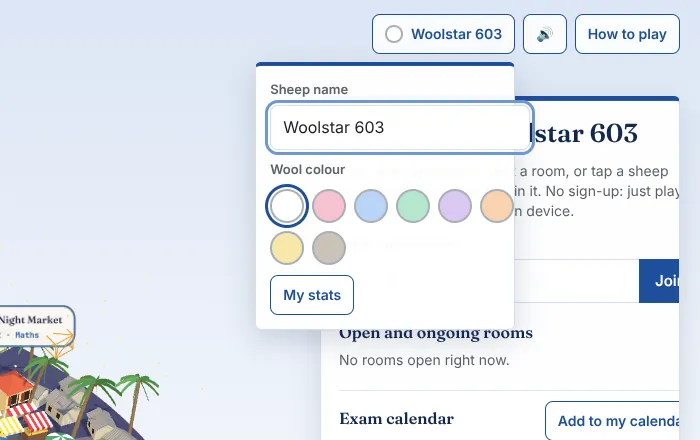
    Open WOOLeD City and you're a sheep straight away. Tap your sheep's name at the top right to choose a name and wool colour. Classmates see you grazing in the city.

    The sheep menu: a name box, the wool colours and My stats
  2. Walk to a kampung

    Tap a kampung on the map or in the row at the bottom. Choose Standard, Mixed or Traps, how many questions, a paper number if you want a particular one (for example MA-37) and the minutes, and untick any topics you don't need. Then press Group to generate a room code for classmates, or Solo to start the paper straight away on your own.

    Numeri Night Market's panel: Standard, Mixed and Traps, a Methods reference button, questions, paper number, minutes and topics
  3. Gather your flock

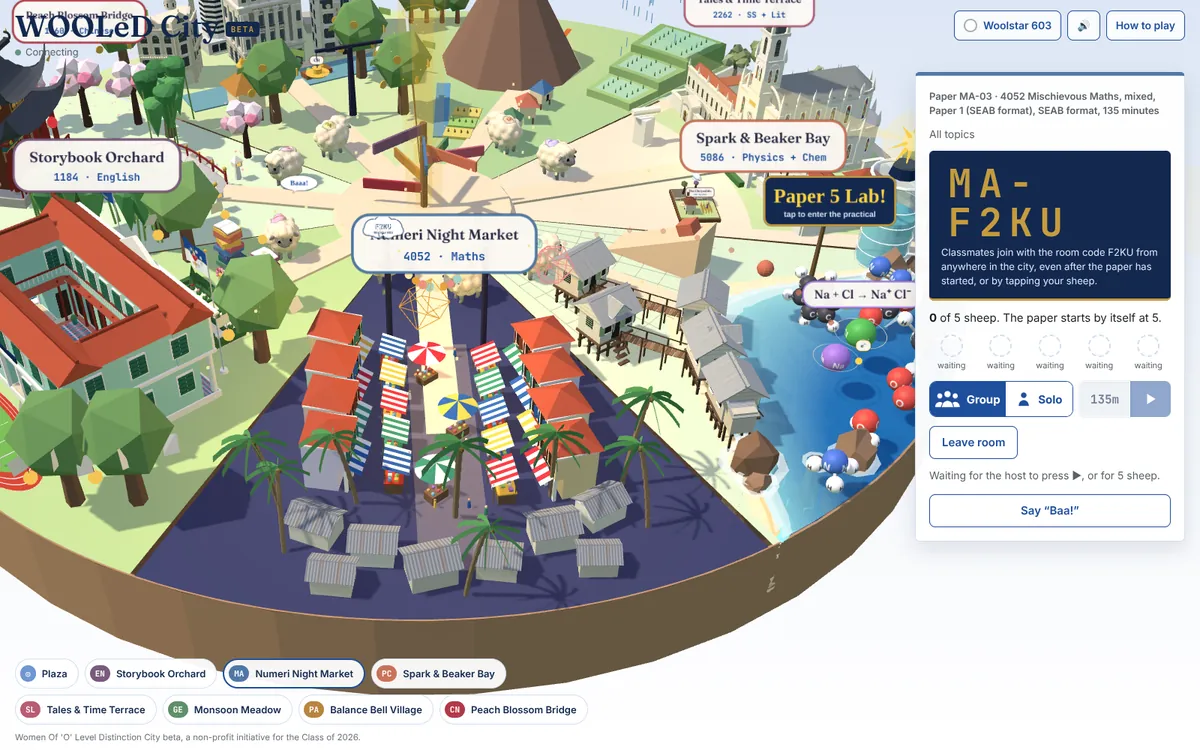
    Share your room code. Classmates type it into Have a room code? anywhere in the city, even from the Plaza, or tap your Thinking Sheep. At five sheep the paper starts for everyone; the host can press ▶ to start sooner. Latecomers can still join while the paper is under way.

    Room MA-6RK5 waiting to start: three of five sheep in, the paper MA-81, and the ▶ start button
  4. Sit the paper together

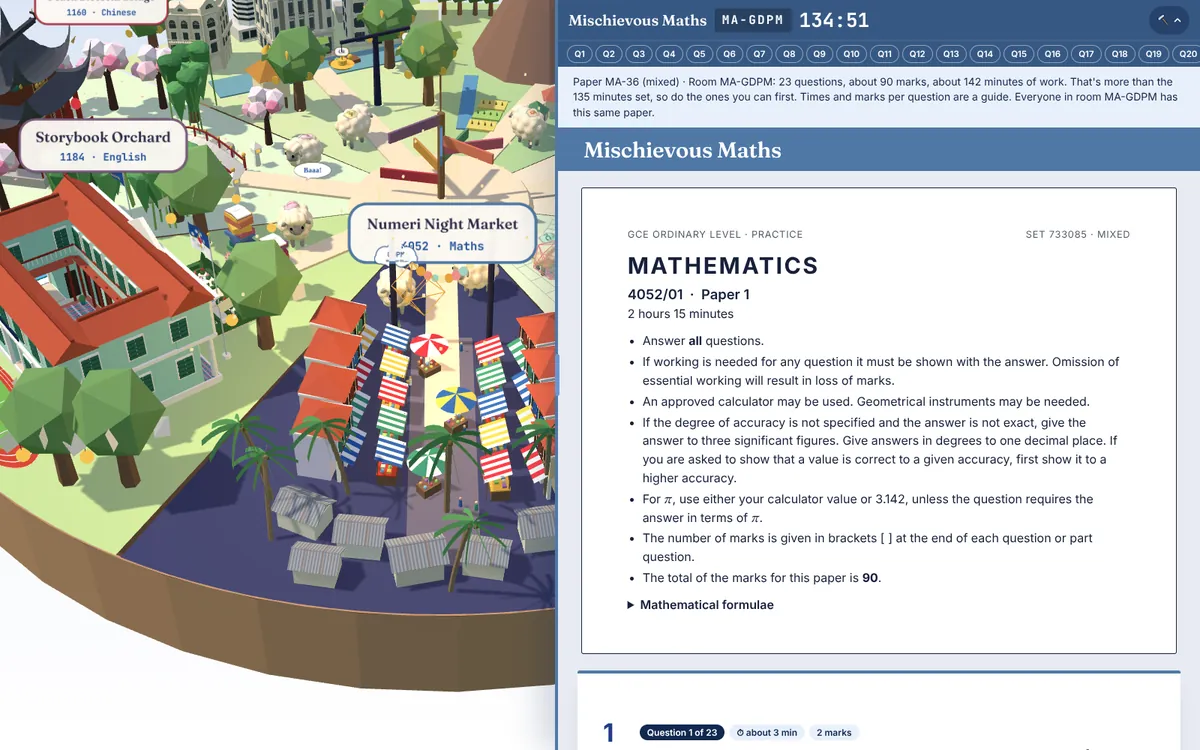
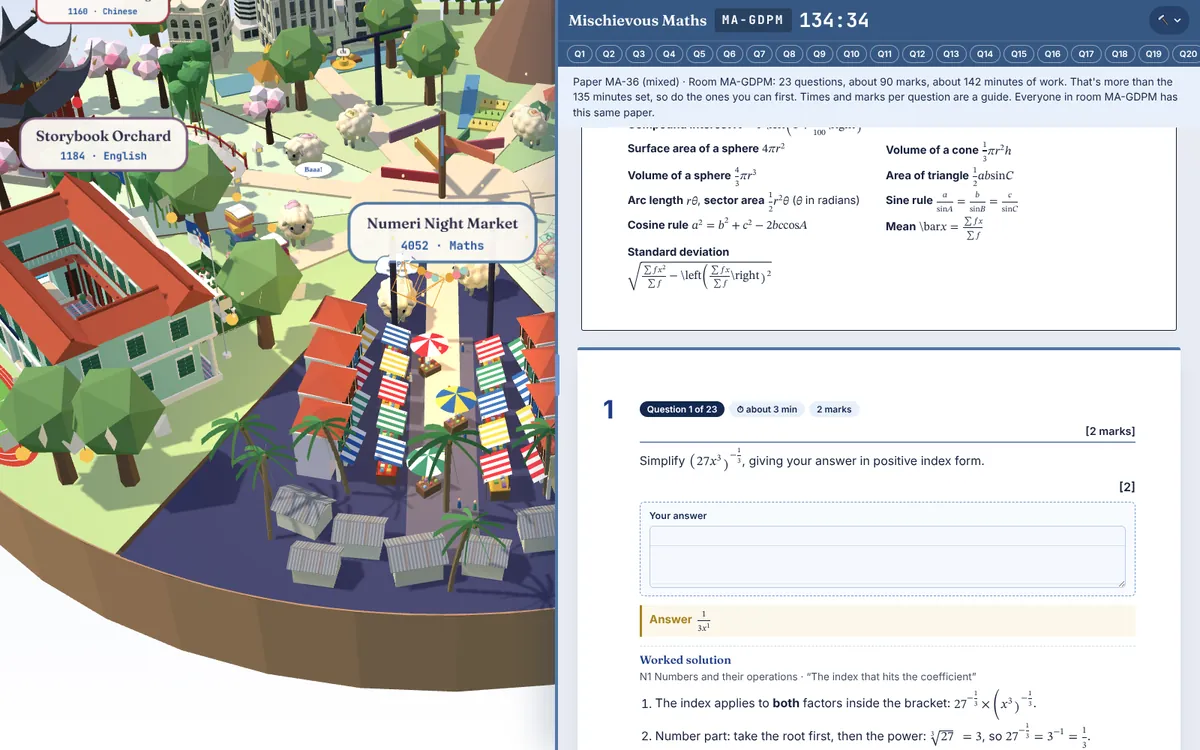
    Everyone gets the same paper and the same clock. Type your answers in the boxes. The hammer at the top right opens the tools: worked answers and guided solutions (locked until time is up when classmates are in the room), the − Aa + text size, a 5 ‖ break for everyone, and ■ to end. Folded away, a row of Q numbers lets you jump to any question.

    A Mischievous Maths paper: room code and clock at the top, the tools, and the first question with its answer box
  5. Mark yourself

    When the timer ends, the worked solutions, gotchas and what-they-don't-tell-you notes open under every question. Your typed answers are checked for you; confirm each one as Right or Not yet, then enter your score.

    Time is up: worked solutions under the question and the Mark your paper box
  6. Keep your record

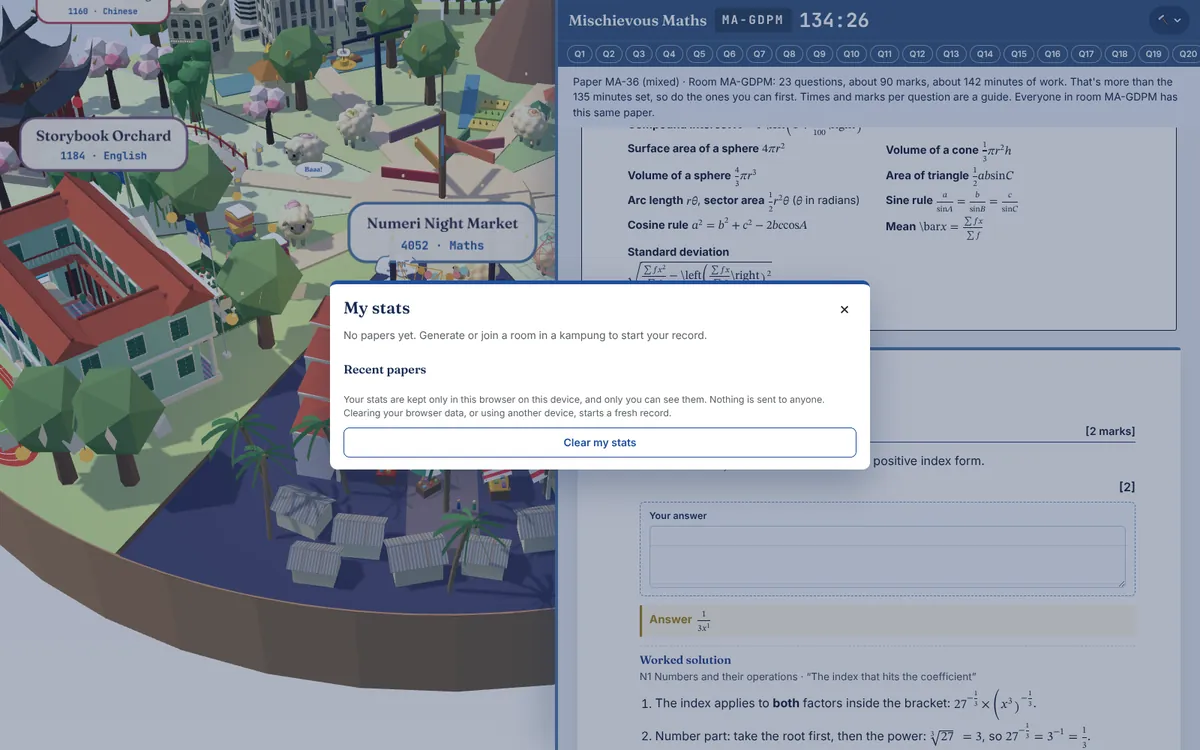
    My stats shows every paper you've sat: time spent, your best score per subject, and each paper's name so you can press ↻ Sit again. It's kept only in your browser, and only you can see it.

    My stats: papers per subject, time, highest scores, and recent papers with Sit again buttons

Methods and Scaffolds: just review

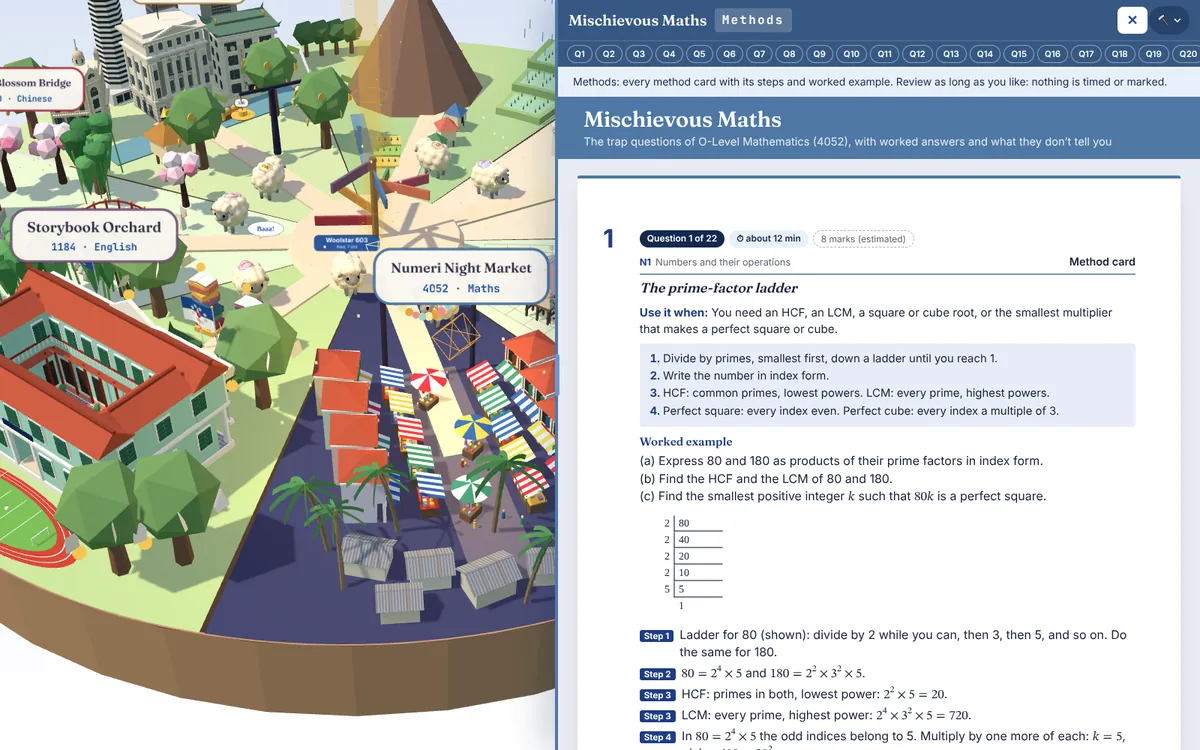
Every kampung has a reference to read at your own pace. Numeri Night Market has Methods: each method card with its steps and a worked example. The other kampungs have Scaffolds: the answer frameworks examiners reward. Press the 📖 button in the kampung: it opens straight away, with no room, no timer and nothing to mark.

The Methods reference: method cards with steps and worked examples, and a row of numbers to jump between them

What you can review, subject by subject

Every question comes with more than an answer. Here is what each kampung gives you, and how to open it.

Worked solutions

The answer with every step of working, and the marks it earns. Open Worked answers under the hammer.

Gotchas

The fast answer that loses marks, the common slip, and why. Open Guided solutions under the hammer.

What they don't tell you

What the syllabus never spells out but examiners expect. Also under Guided solutions.

Methods & Scaffolds

Step-by-step methods (Maths) and answer frameworks (every other subject). Press 📖 in the kampung: no room, no timer.

Practising solo, you can open worked answers and guided solutions at any time (the paper is then noted as practice in your stats). In a room with classmates they unlock for everyone when the timer ends.

1184 English · Storybook Orchard

  • Worked answers for every question, with the fast-brain trap the question is built around.
  • Scaffolds: a routine for each question type, such as see, suggest, explain for visual texts, a two-pass MCQ routine, true / false with evidence, and tone and attitude.
  • Editing and writing: type corrections line by line and plan writing in the lined boxes.

4052 Mathematics · Numeri Night Market

  • Worked solutions with the trap and the common slips marked.
  • Methods: a method card per topic with its steps and a worked example, such as the prime-factor ladder for HCF and LCM.
  • Standard questions practise the method; Traps test whether it holds under pressure.

5086 Physics + Chemistry · Spark & Beaker Bay

  • Worked solutions with a list of gotchas for each question.
  • Scaffolds numbered to the 5086 syllabus, for example how to anchor a qualitative-analysis answer on the most distinctive observation, or when gas volumes can be compared directly.
  • Paper 5: the practicals live in the Spark & Beaker Lab, each station with show answers, guided solutions, gotchas and what they don't tell you.

2262 Social Studies + Literature · Tales & Time Terrace

  • Choose your paper: Paper 1 Social Studies (2262/01, 1 h 45 min) or Paper 2 Literature (2262/02, 1 h 40 min), each in its SEAB format. For Literature, pick your set text: The Chrysalids (the default) or All the Light We Cannot See.
  • Text guides: a short summary, key observations with highlighted key words, a mind map of characters, themes, settings, symbols, narrative and key moments, and essay, passage and unseen scaffolds. Press 📖 Scaffolds & text guides.
  • Worked answers showing where the marks are, with the fast-brain trap.
  • Scaffolds: paragraph frameworks commonly taught in Singapore schools, such as PEEL and PEELJ for source-based and essay answers.
  • What they don't tell you: how the explain and evaluate steps are actually marked.

2279 Geography · Monsoon Meadow

  • Worked answers with gotchas for each question.
  • Answer scaffolds such as PEEL for explain questions and TEA for using data and evidence.
  • What they don't tell you: the terms and examples examiners look for.

7087 Principles of Accounts · Balance Bell Village

  • Worked solutions laid out as the entries, statements and ratios you'd write.
  • Gotchas: the classic slips, from the wrong side of an entry to ratio traps.
  • What they don't tell you: the conventions markers expect in your layout.

1160 Chinese · Peach Blossom Bridge

  • Choose your paper: Paper 1 writing (1160/01, 60 marks), Paper 2 comprehension (1160/02, 70 marks) or Paper 3 listening (1160/03, 20 marks), each in its SEAB format, or practise by topic.
  • 拼音 Pinyin and English: switch on Hanyu Pinyin over every character, and an English translation under each passage, question, option and answer. Find both under the hammer, any time, even in a group room.
  • Writing boxes count your characters (字) as you type, so you can pace each email and composition.
  • Paper 3 plays each recording twice, then the MCQs are marked for you when time is up. Use a browser with a Chinese voice.

Spark & Beaker Lab: Paper 5 practicals

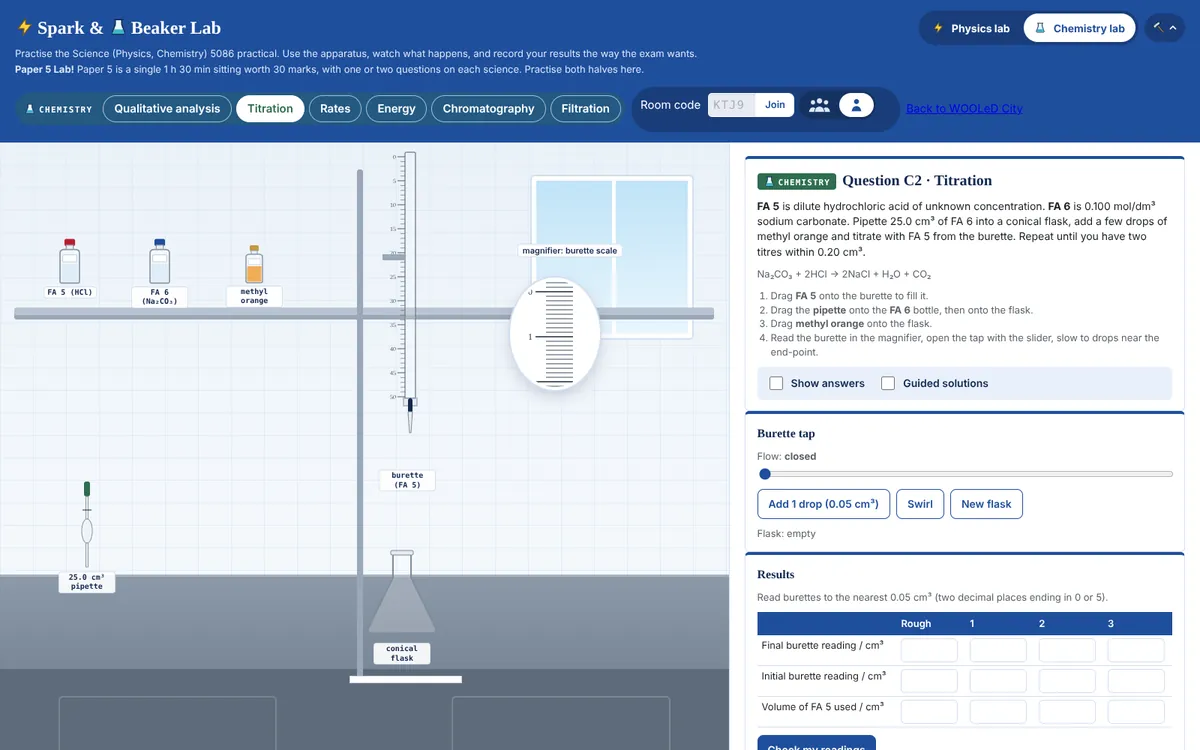
Tap the beaker lighthouse in Spark & Beaker Bay, or its Paper 5 Lab! sign. Switch between the ⚡ Physics lab and the 🧪 Chemistry lab, six stations each: pendulum, density, moments, light, resistance and thermal; qualitative analysis, titration, rates, energy, chromatography and filtration. Use the apparatus, read the scales through the magnifiers, record your results and check them. Practise solo, or press the three-person button for a room so friends get the same unknowns and one shared Paper 5 clock.
The titration station: burette with a magnifier, flask, indicator, and the results table

Good to know

Seven kampungs, one per subject

Each kampung has its own question bank, built around the mistakes examiners see most often.

Three kinds of question set

Standard

Exam-style questions to practise the method, step by step.

Mixed

Standard and trap questions, shuffled, the way a real paper feels. This is the default.

Traps

Questions where the fast answer is the wrong one. Slow down and check.

Ready?

Pick a kampung, gather your flock, and spring the traps before the exam does.

Play now, no sign-up